


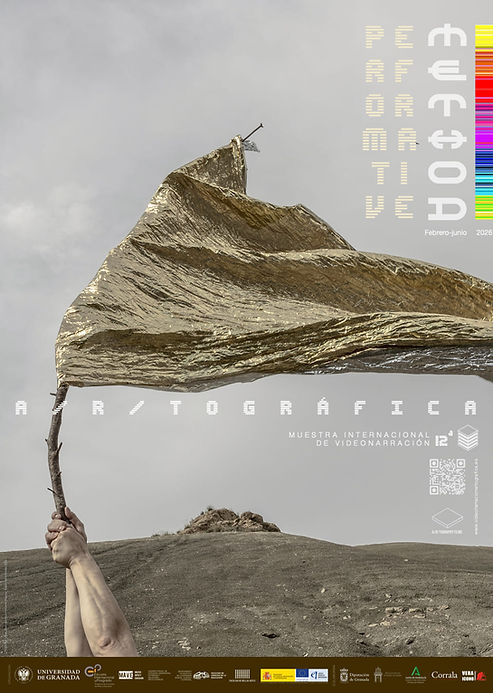
A/R/TOGRÁFICA
Performative Method
febrero-julio 2026
Dirección /Direction
Ángel García Roldán
Fernando Bayona González
Coordinación /Coordination
Xabier Molinet Medina
María de los Ángeles González Merino
Laura López Sánchez
Belén Rico Maturana
Iluminada González Agudo
Javier Valseca Delgado
Programa /Program
Ángel García Roldán
PROGRAMA GENERAL
PROGRAMA SEMINARIO
MONOGRAPHIC ESTEROTIPOS
RESILAB I
PROGRAMA PROYECCIONES
PROGRAMA III FORO
MONOGRAPHIC NARRATIVAS IA
MONOGRAPHIC CONFLUENCIAS PERFORMATIVAS
RESILAB II
RESILAB I
PRESENTACIÓN
RESILAB II
Performative Method:
ser en el relato continuo
Performative Method:
being-video in continuous narrative
Texto /Tex:
Ángel García Roldán
Coordinación /Coordination
A/R/TOGRÁFICA
Filming is not merely looking, but entering the instant and inhabiting it.
Every moving image captures, unfolds, and transforms time, as well as what occurs within it. The camera is not simply an instrument that records or fabricates events; it is the possibility of understanding that another point of view is always possible, if we consider as a primary perspective the gaze itself that situates us within the unfolding of events. Therefore, each frame becomes a territory where lived experience may trigger continuous narrative or continuarration—that act of proceeding, prolonging, or resuming without interruption.
A/R/TOGRÁFICA, in its 12th edition, invites us to understand this relationship between memory, gesture, and presence within the expansive territory of audiovisual art, assuming that we inhabit a world of connections—narratives—both inside and outside our own history. Being-video ultimately means understanding ourselves as multiple possibilities of becoming.
Performativity, as an audiovisual method, implies understanding the video-image or the filmed image as action: it does not accurately portray what we are, but rehearses and activates the connectors of what we may become, engaging not only actions and their protagonists, but also their ideologies and the metaphorical-poetic connections of their outcomes.
Experimental audiovisual practices and a/r/tography emerge as a form of thought in motion: researching through creating, learning through experimenting, living through narrating. Each gesture, each edit, each moment of light and shadow becomes both question and answer, resonating between what we do and what emerges in dialogue with the unexpected—a singular point of reference from the previous edition entitled Unexpected Method.
After twelve years of exploration around A/r/tography Films, the exhibition consolidates itself as a platform for the development of audiovisual A/r/tography. What began as an annual gathering has now evolved into an organic, open, and permeable ecosystem where residencies, laboratories, exhibitions, forums, and international networks weave a collective fabric in real time, materializing visual ideas in which authorship, thought, and construction are questioned, redefining shared, expanded, and collaborative positions around audiovisual narrative.
The A/R/TOGRÁFICA program runs from February 20 to July 31, 2026, across the venues of the Palacio de los Condes de Gabia—where screenings, lectures, exhibitions, and performances converge—and the Filmoteca de Andalucía, which in this edition joins with its Granada venue and its official headquarters in Córdoba, extending the dialogue of experimental video toward new territories, audiences, and cultural contexts.
Since its earliest editions, A/R/TOGRÁFICA has fostered encounter, debate, and production. The first Residency-Laboratory (Resi-Lab), devoted to strengthening a/r/tographic micro-communities and developed in the previous edition with artist and researcher Amaia Molinet, is consolidated this year through the residencies of Rubén Martín de Lucas—an explorer of territory and boundaries as devices for political and ecological reflection—and Sara Crevillen, whose practice articulates audiovisual experimentation within the contested field of artificial intelligence.
In both residencies, the performative method will trigger experimental practices within laboratory settings where invited artists activate collective creative processes with participants. Landscape, coexistence, and shared production intertwine to generate meta-narratives about experience itself.
The lecture series A/R/TOGRAPHY Films. Instruments for Research and Audiovisual Learning, integrated into the PhD Program in Arts and Education, brings together filmmakers such as the Portuguese Pedro Neves, addressing memory and its distortion in documentary narrative; the artist Juan López López, who will discuss landscape as infrastructure in his experimental cinematography; and the artist-performer Verónica Ruth Frías, who presents her work on audiovisual instrumentalization of action as a feminist device and symbol of resistance, drawing from the methodological legacy of Marina Abramović.
Regarding the exhibitions produced by A/R/TOGRÁFICA, the first stems from the international project ARQUETŸPE, which articulates an inter-university laboratory with faculty and students from the Universidad de Granada, the Universidad de Murcia, and the Accademia di Belle Arti di Bari. Its results will form part of an exhibition touring three venues: Palacio del Almirante (University of Granada) from April 14–24; Museo de la Ciudad de Murcia from May 12–24; and Palazzo Roberti in Mola di Bari from June 23–28. The project reinterprets cultural archetypes through visual creation across diverse fields of contemporary artistic education.
Throughout July, the Palacio de los Condes de Gabia will host the third edition of the Artificial Intelligence exhibition-laboratory, this year centered on audiovisual narrative developments. It reflects on how AI dialogues with or challenges creative processes, transforming technological applicability into a critical human-machine interlocution within the broader field of art.
The A/R/TOGRÁFICA 2026 program also includes the Official Program of the International Videonarration Exhibition, structured into ten sections functioning both as autonomous modules and as nodes within a relational network where video unfolds as process, experience, and pedagogy.
Firstly, the FILMOGRAPHIES section will screen the films Agua fría (2012), Posada (2014), La playa (2016), La fábrica (2019), and Los seguidores de la revolución (2023) by the Portuguese filmmaker Pedro Neves; as well as Edén (2025), an experimental feature film by Juan López López.
In the INVITED PROJECTS section, we will present works by Mario Gutiérrez Cru and Ximena Cabral. The NEW A/R/TOGRAPHY section will showcase the production of a/r/tographer Laura López Sánchez. The A/R/TOGRAPHY FILMS section will gather in-house productions created within the different audiovisual a/r/tography laboratories affiliated with the Universidad de Granada.
The MONOGRAPHIC cycles will maintain major thematic axes focused on generative narrative creation (AI), memory and audiovisual heritage, and the essay as a structure of audiovisual knowledge.
We will also include the LANDSCAPES section (audiovisual performances) and the section dedicated to INTERNATIONAL CURATORSHIPS, linked both to A/R/TOGRÁFICA’s collaborating projects and to the project “A/r/tographic-Lab Chicago” (USA), curated by a/r/tographer Juan Antonio Baños; the curatorial project by Ximena Cabral entitled «Lo que existe / lo que subsiste / lo que perece» (Córdoba, Argentina); and the curatorship by Juan-Antonio Barbancho centered on the work of Brazilian artist Beth Moysés.
Additionally, the INTERNATIONAL AUDIOVISUAL TRAINING PROJECTS are incorporated: the project from the Universidad del Valle (Medellín, Colombia), curated by filmmaker and professor Antonio Dorado Zúñiga; the project from the Universidad Pedagógica Nacional, «Cortodianidad. Fragmentos de memoria audiovisual» (Bogotá, Colombia), curated by Edward Guerrero Chinome; the project from the Escola Superior de Música de Catalunya (ESMUC), curated by artist, researcher, and professor Úrsula San Cristóbal; the project from the Faculty of Fine Arts of the University of Málaga, directed by Eugenio Rivas Herencia; and the project led by professors Iñaki Pablo Ramos San Antón, from the Escuela de Artes y Estudios Superiores de Córdoba, Mateo Inurria, and Maite García Ribot, from the Escuela de Arte y Superior de Diseño EASD José Val del Omar.
The FESTIVALES section will feature the curatorship of Mario Gutiérrez Cru, director of «PROYECTOR. Plataforma de Imagen en Movimiento» (Madrid, Spain); Hernando Urrutia, director of «IMAGE PLAY International Video Art Festival» (Funchal, Portugal); and Clara Foronda Cortés, representing the Festival de Cortos Caseros del Cine de Canena (Jaén, Spain).
In this edition, the III Foro Encuentros sobre Creación, Investigación y Formación Audiovisual includes the meeting organized by the University of Málaga project SURTOPÍA Plataforma de Acción Sociocultural, which proposes a creative journey through pedagogy to explore new art–society relationships in our time.
The exhibition continues to grow and expand, as do the convergences surrounding its INTERNATIONAL CALL, which traces a plural map of contemporary videonarration. The works of Nathan Le Graciet, Inés G. Aparicio, Mario Espliego, Isabel Pérez Del Pulgar, Víctor Orozco Ramírez, Josefina Lens, Alba González Torres, Ismael Sordo Sánchez, Raúl Melero Millán, Francisco Pradilla Barrero, Marco Joubet, Frank Lahera O’Callaghan, Raphaël Martin-Dumazer, Ana Paloma Molina, Fátima Luzardo, and Jahaziel Tiznado & Mariela Torres configure a territory of memory, identity, body, and landscape that dialogues from France, Spain, Argentina, Germany, Canada, Cuba, and Mexico.
In sum, A/R/TOGRÁFICA is a performative gesture that mobilizes a community of creators, researchers, and educators, activating the spectator within a shared experience.
After twelve years, A/R/TOGRÁFICA continues to consolidate itself as a powerful catalyst for innovation, a space for R&D+i and knowledge transfer in arts education, and an agent of cultural production from the university community toward the city. Yet beyond its institutional structure, its true identity resides in the gesture that sustains it: assuming that every image is action and that every action may become a situated narrative that defines us, transforms us, and propels us into the future.
Ultimately, Being-video in continuous narrative means inhabiting a story in permanent construction, where audiovisual a/r/tography does not describe the world: it rehearses it, performs it, and transforms it.
Filmar no es solo mirar, sino entrar en el instante y habitarlo.
Cada imagen en movimiento atrapa, despliega y transforma el tiempo, así como lo que sucede en él. La cámara no es solo un instrumento que registra o fabrica hechos; es la posibilidad de entender que siempre es posible otro punto de vista si consideramos como primer enfoque el de la propia mirada, que nos sitúa en el devenir de los acontecimientos. Por lo tanto, cada encuadre es un territorio donde lo que se vive puede desencadenar el relato continuo o continuarración —ese acto de proseguir, prolongar o reanudar sin interrupción—.
A/R/TOGRÁFICA, en su 12.ª edición, nos emplaza a comprender esta relación entre memoria, gesto y presencia dentro del territorio expansivo del arte audiovisual, asumiendo que habitamos un mundo de conexiones —relatos— dentro y fuera de nuestra propia historia. Ser-vídeo es, en definitiva, entendernos como múltiples posibilidades de ser.
La performatividad, como método audiovisual, implica entender la imagen-vídeo o la imagen filmada como acción: no retrata de forma exacta lo que somos, sino que ensaya y activa los conectores de lo que podemos llegar a ser, comprometiendo no solo las acciones y sus protagonistas, sino también sus idearios y las conexiones metafórico-poéticas de sus resultados.
El audiovisual experimental y la a/r/tografía emergen como una forma de pensamiento en movimiento: investigar creando, aprender experimentando, vivir narrando. Cada gesto, cada montaje, cada instante de luz y sombra se convierte en una pregunta y en una respuesta, con resonancias entre lo que hacemos y lo que surge en diálogo con lo inesperado —singular punto de referencia de la edición pasada, titulada Unexpected Method—.
Tras doce años de exploración en torno a las A/r/tography Films, la muestra se consolida como plataforma para el desarrollo de la A/r/tografía audiovisual. Lo que comenzó como un encuentro anual se transforma ahora en un ecosistema orgánico, abierto y permeable, donde residencias, laboratorios, exposiciones, foros y redes internacionales tejen una trama colectiva en tiempo real, materializando ideas visuales en las que autoría, pensamiento y construcción se cuestionan, redefiniendo posicionamientos comunes, expandidos y colaborativos en torno al relato audiovisual.
El programa de A/R/TOGRÁFICA se despliega entre el 20 de febrero y el 31 de julio de 2026 en las sedes del Palacio de los Condes de Gabia, donde proyecciones, conferencias, exposiciones y performances conviven, y la Filmoteca de Andalucía, que en esta edición se suma con su sede en Granada y con la sede oficial de Córdoba, extendiendo el diálogo del vídeo experimental hacia nuevos territorios, públicos y contextos culturales.
Desde las primeras ediciones, A/R/TOGRÁFICA ha apostado por el encuentro, el debate y la producción. La primera Residencia-laboratorio (Resi-Lab) para la potenciación de microcomunidades a/r/tográficas, desarrollada en la edición pasada con la artista e investigadora Amaia Molinet, se consolida en esta edición con las estancias de Rubén Martín de Lucas, explorador de territorios y límites como dispositivos de reflexión política y ecológica, y Sara Crevillen, cuya práctica articula la experimentación audiovisual desde el controvertido territorio de la inteligencia artificial.
En ambas residencias, el método performativo desencadenará prácticas experimentales en laboratorios donde los artistas invitados activarán procesos colectivos de creación con los participantes. Paisaje, convivencia y producción compartida se entrelazan para generar metanarrativas sobre la propia experiencia.
El ciclo de conferencias A/R/TOGRAPHY Films. Instrumentos para la investigación y el aprendizaje audiovisual, integrado en el programa de doctorado en Artes y Educación, reúne este año a cineastas como el portugués Pedro Neves, en torno a la memoria y su distorsión en el relato documental; el artista Juan López López, que abordará el paisaje como infraestructura en su cinematografía experimental; y la artista-performer Verónica Ruth Frías, que presentará su trabajo de instrumentalización audiovisual en torno a la acción como dispositivo y símbolo feminista de resistencia, a partir de la herencia metodológica de Marina Abramović.
Respecto a las exposiciones producidas por A/R/TOGRÁFICA, la primera surge del proyecto internacional titulado ARQUETŸPE, que articula un laboratorio interuniversitario con profesorado y estudiantes de la Universidad de Granada, la Universidad de Murcia y la Accademia di Belle Arti di Bari. Sus resultados formarán parte de una exposición que itinerará por tres espacios expositivos: el Palacio del Almirante de la Universidad de Granada (del 14 al 24 de abril); el Museo de la Ciudad de Murcia (del 12 al 24 de mayo); y el Palazzo Roberti, en Mola di Bari (del 23 al 28 de junio). El proyecto ha servido para reinterpretar arquetipos culturales a través de la creación visual en distintos ámbitos de la formación artística contemporánea.
A lo largo del mes de julio tendrá lugar, en el Palacio de los Condes de Gabia, la tercera edición de la exposición-laboratorio sobre inteligencia artificial, que este año se centra en desarrollos narrativos audiovisuales y reflexiona en torno a cómo la inteligencia artificial dialoga o tensiona los procesos creativos, transformando la aplicabilidad tecnológica en procesos de interlocución crítica humano-máquina dentro del amplio territorio del arte.
La programación de A/R/TOGRÁFICA 2026 también incluye el Programa Oficial de la Muestra Internacional de Videonarración, que articula diez secciones que funcionan como módulos autónomos y como nodos en una red de relaciones donde el vídeo se despliega como proceso, experiencia y pedagogía.
En primer lugar, la sección FILMOGRAFÍAS exhibirá los metrajes Agua fría (2012), Posada (2014), La playa (2016), La fábrica (2019) y Los seguidores de la revolución (2023), del portugués Pedro Neves; así como Edén (2025), largometraje experimental de Juan López López.
En la sección PROYECTOS INVITADOS contaremos con las obras de Mario Gutiérrez Cru y Ximena Cabral. La sección NUEVA A/R/TOGRAFÍA presentará la producción de la a/r/tógrafa Laura López Sánchez. La sección A/R/TOGRAPHY FILMS recogerá metrajes de producción propia realizados en los distintos laboratorios de a/r/tografía audiovisual vinculados a la Universidad de Granada.
Los ciclos MONOGRAPHIC mantendrán grandes ejes temáticos en torno a la creación narrativa generativa (IA), la memoria y el patrimonio audiovisual, y el ensayo como estructura de conocimiento audiovisual.
También contaremos con la sección LANDSCAPES (performances audiovisuales) y con la dedicada a COMISARIADOS INTERNACIONALES, vinculados tanto a los proyectos colaboradores de A/R/TOGRÁFICA como al proyecto “A/r/tographic-Lab Chicago” (EE. UU.), comisariado por el a/r/tógrafo Juan Antonio Baños; el comisariado de Ximena Cabral, titulado «Lo que existe / lo que subsiste / lo que perece» (Córdoba, Argentina); y el comisariado de Juan-Antonio Barbancho en torno a la obra de la artista brasileña Beth Moysés.
Asimismo, se integran los PROYECTOS INTERNACIONALES DE FORMACIÓN AUDIOVISUAL: el de la Universidad del Valle (Medellín, Colombia), comisariado por el cineasta y profesor Antonio Dorado Zúñiga; el de la Universidad Pedagógica Nacional, «Cortodianidad. Fragmentos de memoria audiovisual» (Bogotá, Colombia), comisariado por Edward Guerrero Chinome; el de la Escola Superior de Música de Catalunya (ESMUC), comisariado por la artista, investigadora y profesora Úrsula San Cristóbal; el de la Facultad de Bellas Artes de la Universidad de Málaga, dirigido por Eugenio Rivas Herencia; y el de los profesores Iñaki Pablo Ramos San Antón, de la Escuela de Artes y Estudios Superiores de Córdoba, Mateo Inurria, y Maite García Ribot, de la Escuela de Arte y Superior de Diseño EASD José Val del Omar.
La sección FESTIVALES contará con el comisariado de Mario Gutiérrez Cru, director de «PROYECTOR. Plataforma de Imagen en Movimiento» (Madrid, España); el de Hernando Urrutia, director de «IMAGE PLAY International Video Art Festival» (Funchal, Portugal); y el de Clara Foronda Cortés, con el Festival de Cortos Caseros del Cine de Canena (Jaén, España).
En esta edición, el III Foro Encuentros sobre Creación, Investigación y Formación Audiovisual recoge el encuentro organizado por el proyecto de la Universidad de Málaga, SURTOPÍA Plataforma de Acción Sociocultural, que propone un viaje creativo a través de la pedagogía para explorar nuevas relaciones arte-sociedad en nuestro tiempo.
La muestra crece y se extiende, así como las afluencias y confluencias en torno a su CONVOCATORIA INTERNACIONAL, que traza un mapa plural de la videonarración contemporánea. Las obras de Nathan Le Graciet, Inés G. Aparicio, Mario Espliego, Isabel Pérez Del Pulgar, Víctor Orozco Ramírez, Josefina Lens, Alba González Torres, Ismael Sordo Sánchez, Raúl Melero Millán, Francisco Pradilla Barrero, Marco Joubet, Frank Lahera O’Callaghan, Raphaël Martin-Dumazer, Ana Paloma Molina, Fátima Luzardo y Jahaziel Tiznado & Mariela Torres configuran un territorio de memoria, identidad, cuerpo y paisaje que dialoga desde Francia, España, Argentina, Alemania, Canadá, Cuba y México.
A/R/TOGRÁFICA es, en suma, un gesto performativo que moviliza a una comunidad de creadores, investigadores y formadores, activando al espectador en una experiencia compartida.
Tras doce años, A/R/TOGRÁFICA sigue consolidándose como un potente catalizador de innovación, un espacio de investigación I+D+i y de transferencia en educación artística, y un agente productor de cultura desde la comunidad universitaria hacia la ciudad. Pero, más allá de la estructura institucional, su verdadera identidad reside en el gesto que la sostiene: asumir que toda imagen es acción y que toda acción puede devenir en relato circunstancial que nos define, nos transforma y nos impulsa hacia el futuro.
En definitiva, Ser-vídeo en el relato continuo significa habitar una narrativa en permanente construcción, donde la a/r/tografía audiovisual no describe el mundo: lo ensaya, lo performa y lo transforma.

#1. FILMOGRAFIAS

#3. NUEVA A/R/TOGRAFÍA

#4. A/R/TOGRAPHY FILMS

#5 MONOGRAPHIC. NARRATIVAS GENERATIVAS

#5 MONOGRAPHIC. MEMORIA Y LEGADO

#5 MONOGRAPHIC. A/R/TIVISMO QUEER

#6 PROYECTOS INTERNACIONALES DE FORMACIÓN AUDIOVISUAL. IMAGEN: RECORDAR – TRANSITAR

#7 COMISARIADOS INTERNACIONALES. Isabel Pérez del Pulgar. (FR/ES)

#7 COMISARIADOS INTERNACIONALES. Úrsula San Cristóbal

#7. COMISARIADOS INTERNACIONALES. Juan Baños

#7 COMISARIADOS INTERNACIONALES. Eugenio Rivas Herencia

#9 NARRATIVE LANDSCAPES. Juan López López

#11 FESTIVALES FESTIVAL DE CORTOS CASEROS DE “EL CINE DE CANENA”.

#11 FESTIVALES. IMAGE PLAY

#11 FESTIVALES. PROYECTOR. BEST OFF
